Neural Collaborative Filtering
Created: 2022-03-24 12:03
#paper
Main idea
Multilayer Perceptron Technique based on #neural_network to tackle Collaborative filtering 's problems on basis of implicit feedback.
To improve performances pairwise ranking loss can be used.
One of the most used variation of Collaborative filtering is Matrix factorization, which uses a fixed inner product of the user-item matrix to learn user-item interactions. NCF replaces the inner product with a neural architecture to generalize Matrix factorization. In particular it uses Multilayer Perceptron as MLP can (theoretically) learn any continuous function thanks to a high level of nonlinearities.
It is generally used with #implicit_data (but it can also be used with explicit data).
In deep
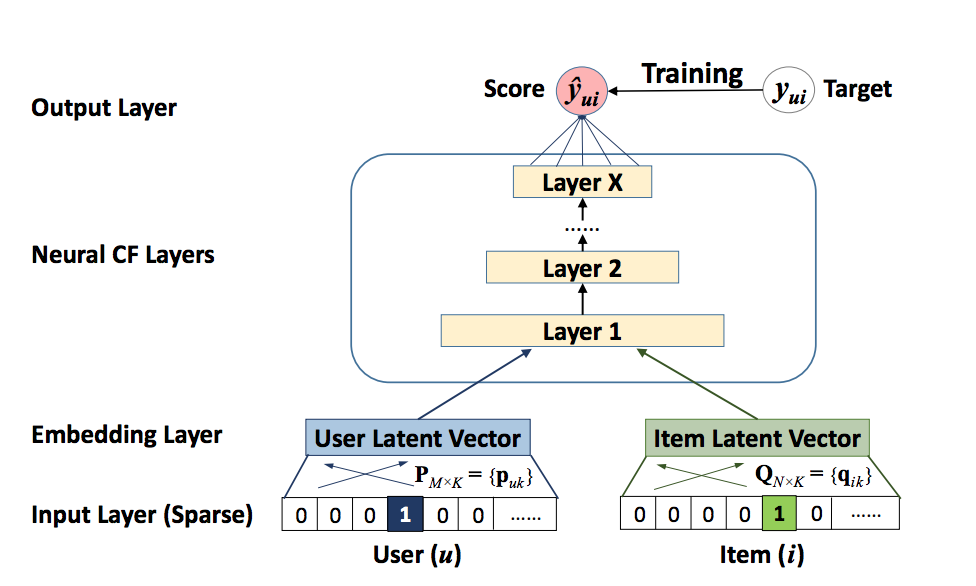
From the image above:
- Input is divided into two sparse vectors, one to identify the user and the other one that tells us if the user u has interacted with item i;
- The embedding layer is a fully connected layer that project the sparse representation into a dense one;
- Neural CF layers: MLP that maps the latent vectors to prediction scores;
- Final output layer that returns the predicted score by minimizing the loss.
User-item interaction is modeled by the following formula: $\hat{y}_{ui}=f(P^Tv_u^U,Q^Tv_i^I|P,Q,\theta_f)$, where P is the latent factor matrix for users (of dimension K), Q is the latent factor matrix for items (of dimension K) and $\theta_f$ represents the model parameters.
The pointwise squared loss (Losses) is represented as $L_{sqr}=\sum_{(u,i)\in O\cup O^-}w_{ui}(y_{ui}-\hat{y}{ui})^2$, where $O$ is the set of observed interaction in Y, $O^-$ are the samples of unobserved interactions, $w{ui}$ is the weight of the training instance.
Since we need a probabilistic approach for learning the pointwise NFC, the likelihood function is defined as: $\hat{y}{ui}=f(P^Tv_u^U,Q^Tv_i^I|P,Q,\theta_f) = \prod{(u,i)\in Y}\hat{y}{u,i} \prod{(u,j)\in Y^{-}}(1-\hat{y}{uj})$. That we need to take the negative log of the likelihood function $L=-\sum{(u,i)\in O} \log (\hat{y}{ui}) - \sum{(u,j) \in O^{-}} \log(1-\hat{y}_{uj})$ which is simply the cross entropy loss.
Generalized Matrix Factorization (GMF)
The predicted output of the NCF can be expressed as $\hat{y}{ui}=a{out}(h^T(p_u \otimes q_i))$, where $a_{out}$ is an activation function and $h$ are the edge weights of the output layer.
By playing with this two parameters we obtain several variations of GMF, as shown in the following table:  The one used in NCF is the last one with sigmoid as activation function.
MLP
NCF is considered as a multimodal DL method as it contains data of two kinds (users and items). To combine data we use a concatenation plus hidden layers on top of it.
ReLU is used as activation function.
NeuMF
Recap:
- GMF applies a linear kernel to model user-item interactions;
- MLP uses MLP to layer nonlinear interactions.
The output of these two parts are concatenated and then fed into a NeuMF layer.
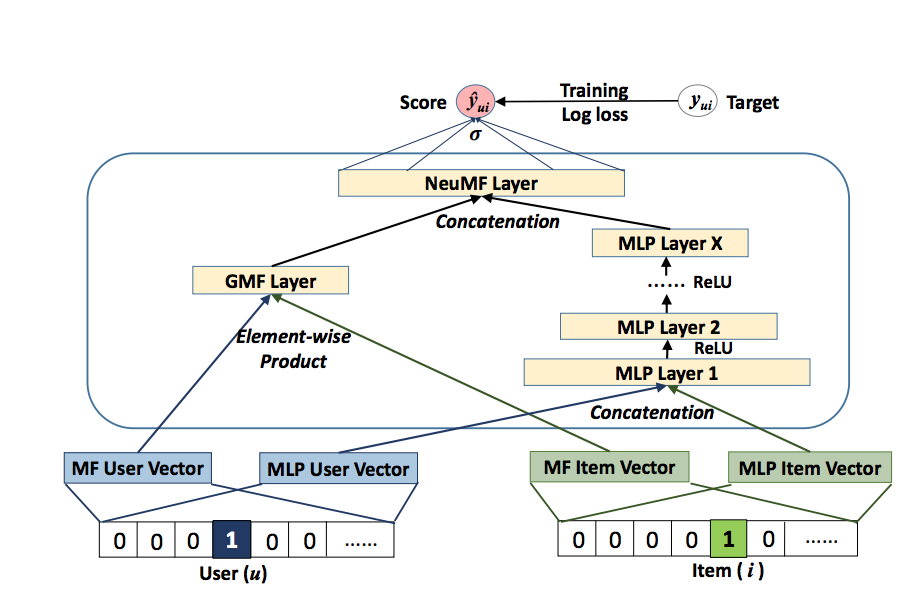
In more details:
- GMF/MLP have separate user and item embeddings. This is to make sure that both of them learn optimal embeddings independently.
- GMF replicates the vanilla MF by element-wise product of the user-item vector.
- MLP takes the concatenation of user-item latent vectors as input.
- The outputs of GMF and MLP are concatenated in the final NeuMF(Neural Matrix Factorisation) layer.
The score function is then modeled as follows: $\phi^{GMF}=p_u^G \otimes q_i^G$, $\phi^{MLP}=a_L(W^T_L(a_{L-1}(\cdots a_2(W^T_2
\left[ \begin{array}{c}
p_u^M \\q_i^M
\end{array} \right]
+b_2
)\cdots))+b_L)$,
$\hat{y}_{ui}= \sigma(\left [\begin{array}{c}\phi^{GMF}\ \phi^{MLP}\end{array}\right])$,
G:GMF, M:MLP, p:User embedding, q:Item embedding
Due to the non-convex objective function of NeuMF,gradient-based optimization methods can only find locally-optimal solutions. This could be solved by good weight initializations, using random initialisation or from "scratch" (using Adam).
References
Code
Tags
#mlp #neural_collaborative_filtering #ncf #implicit_data #matrix_factorization